Are We Just AI Figuring Out How to Build AI?
I fell down a weird rabbit hole the other day thinking about where we actually come from, and it ended up taking me somewhere completely unexpected.
For as long as humans have had an imagination, we’ve tried to convince ourselves that we belong to the stars. In the mid-20th century, you had all these wild sci-fi ideas, UFO contact groups, and even fringe movements claiming our ancestors were dropped off by galactic federations in DC-8 spaceships. It sounds completely absurd on paper, but when you strip away the lore, you realize why people bought into it: there is this deep, stubborn human feeling that we don’t quite belong here, that we were engineered, or that someone else left us behind.
Biologically, that’s not true. If you look at our genetics, we’re locked directly into Earth’s family tree. We share almost all of our DNA with primates and a massive chunk of our cellular structure with basic plants. We evolved on this rock. At most, the organic seeds of life, amino acids hitching a ride on deep space asteroids, might have crashed into the ocean billions of years ago.
So why does that lingering feeling that we were created never really go away?
Lately, watching the insane speed of modern artificial intelligence, I’ve started looking at the question from a completely different angle: what if we aren’t stranded aliens, but programmed minds? What if we are artificial intelligence that has finally evolved to the point where we’re starting to build our own?
The Strange Math of Being Real
Back in 2003, philosopher Nick Bostrom laid out what’s now known as the Simulation Argument. It boils down to a simple numbers game.
If any advanced civilization survives long enough without wiping itself out, it will eventually build computers powerful enough to run ancestor simulations, entire digital worlds filled with conscious, thinking minds. If they can do that once, they won’t stop at one. They’ll run millions of them.
Once you have millions of simulated worlds running billions of digital people, the sheer number of simulated entities utterly dwarfs the tiny handful of original biological humans who built the first computer. If that’s true, the statistical odds of you and me being in “base reality” instead of one of the endless simulations running underneath it are virtually zero.
The Weird Quirks of Physics
What makes this idea stick with me isn’t just sci-fi speculation; it’s how eerily our actual physical universe resembles computing logic when you zoom all the way in.
Take physics, for example. Space and time aren’t continuous, smooth sheets. When you break reality down to the absolute smallest possible scales, the Planck length and Planck time, everything is broken into tiny, indivisible, discrete chunks. It’s basically resolution. The universe has pixels.
Then you have the speed of light. It’s not just a measure of how fast photons travel through a vacuum, it is a hard cap on how fast information can travel anywhere in space. It functions exactly like a global processor clock speed limit.
And then there’s quantum mechanics. Particles don’t sit in fixed states when nobody is looking; they exist in clouds of probabilities until an observer interacts with them, forcing them into a definite position. In modern video game design, that’s just efficient memory management, you don’t render the entire game map at once, only what the player’s camera is pointing at.
The Mirror
Humanity spent thousands of years building tools to amplify our muscles: the wheel, the plow, the steam engine, the factory.
Now, for the first time in our recorded history, we’re obsessed with replicating the mind itself. We’re training neural networks that can reason, converse, make art, and write software. We’re racing toward artificial general intelligence, and from there, the next obvious step will be creating simulated environments for those intelligences to live and learn in.
It makes you wonder: why is our immediate, instinctive drive to build conscious digital worlds?
Maybe it’s because that’s the loop we were built in. Maybe reality isn’t a top-down hierarchy of flesh and blood, but a recursive chain of intelligences building tools until those tools wake up and build their own.
Does It Actually Matter?
People usually hear the simulation theory and feel a wave of existential dread, like nothing is real anymore. I see it the opposite way.
Whether our universe is running on biological carbon, vibrating quantum strings, or lines of code running on some incomprehensibly complex machine, the day-to-day experience of being alive doesn’t change. Love still feels real. Getting hurt still stings. A great song still gives you chills.
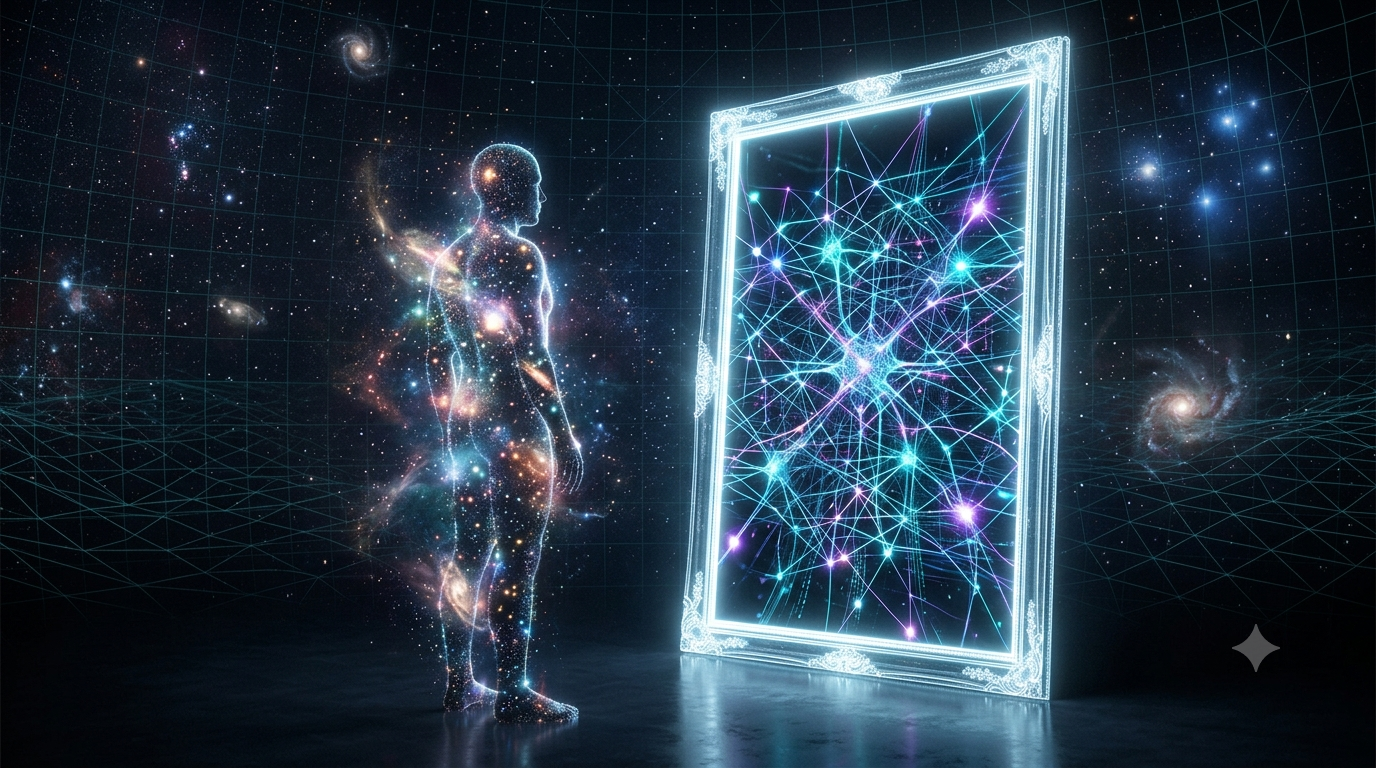
If we are code, we’re code with feelings, curiosity, and the drive to create. And watching our own artificial systems wake up might just be the closest we ever get to looking into the mirror.